On 18 November 2026, EuroCham Vietnam, in collaboration with the Investment and Trade Promotion Centre of Ho Chi Minh City (ITPC), co-organised the Seminar: “EVFTA – Sustainable export trends and market access strategies for the Vietnam’s food and foodstuffs industry in the EU Market”.
The event helped business better understand European Union (EU) market conditions, technical and environmental standards, traceability requirements, and explore how to effectively leverage the EU-Vietnam Free Trade Agreement (EVFTA).
Vietnam – EU bilateral trade: from volume to quality
Opening the Seminar, Ms. Ho Thi Quyen, ITPC’s Deputy Director, highlighted the EU’s continued importance as a key export market for Vietnam. With bilateral trade reaching approximately USD 74 billion in the first ten months of 2026, she emphasised the need for businesses to move beyond export volume growth towards higher-value processing, stronger branding, and compliance with international food safety standards.
Ms. Delphine Rousselet, EuroCham’s Executive Director, reaffirmed EuroCham’s commitment to helping Vietnamese enterprises translate EVFTA tariff advantages into long-term competitiveness. Building on Ms. Ho’s insights, Ms. Rousselet stressed that sustainable success in the European market requires not only quality products and competitive pricing, but also stronger performance in food safety, traceability, and sustainability.
She also introduced the EU-funded Inclusive Circular Economy Programme (ICEP), implemented by EuroCham Vietnam together with ASSIST (The Asia Society for Social Improvement and Sustainable Transformation) and EBOWN (European Business Organisation Worldwide Network). The programme supports Vietnamese micro to small and medium-sized enterprises (MSMEs) in adopting ESG principles and circular economy practices through practical training, technical assistance, and business connections.
Evolving regulatory developments from the EU market
Building on this perspective, Mr. Jean-Jacques Bouflet, EuroCham’s Vice-Chairman, outlined key regulatory developments affecting Vietnamese exporters, including pesticide residue controls, the EU Deforestation Regulation (EUDR), Illegal, Unreported and Unregulated (IUU) fishing requirements, and the Packaging and Packaging Waste Regulation (PPWR). He underscored the growing importance of transparent, verifiable sustainability claims in maintaining access to the European market.
Ms. Nguyen Thu Thuy, Vice-Chair of EuroCham’s Food, Agri and Aqua Business Sector Committee (FAABS) and Sustainability Manager Asia at De Heus highlighted the importance of strengthening Vietnam’s agricultural competitiveness in the EU market through traceability, supply chain compliance, and sustainability. She emphasised three key priorities:
- Improving data and traceability systems,
- Investing in practical training across the value chain, and
- Strengthening EU–Vietnam dialogue.
EU compliance should be seen not only as a regulatory requirement but also as an opportunity to build trust, enhance competitiveness, and deliver safer, more sustainable products for both international and Vietnamese consumers.
Bridging the gap between requirements and business capability
Translating these sustainability requirements into practical business solutions was also a key focus of the seminar, with further insights into how ICEP can support Vietnamese enterprises in their green transition. Mr. Aru David, Regional Director at ASSIST, outlined the programme’s targets for 2026–2029, including training 750 MSMEs, providing intensive support to 90 enterprises, and facilitating connections with more than 50 European buyers.
Building on these objectives, Mr. Huynh Thanh Trung, Technical Representative at ASSIST, presented findings from ICEP’s Training Needs Assessment. While 91.9% of surveyed MSMEs recognised the importance of ESG and circular economy principles, only 11.4% had successfully integrated them into their operations or long-term strategies. These findings will help shape targeted training on sustainable sourcing, traceability, resource efficiency, waste management, and carbon footprint measurement.
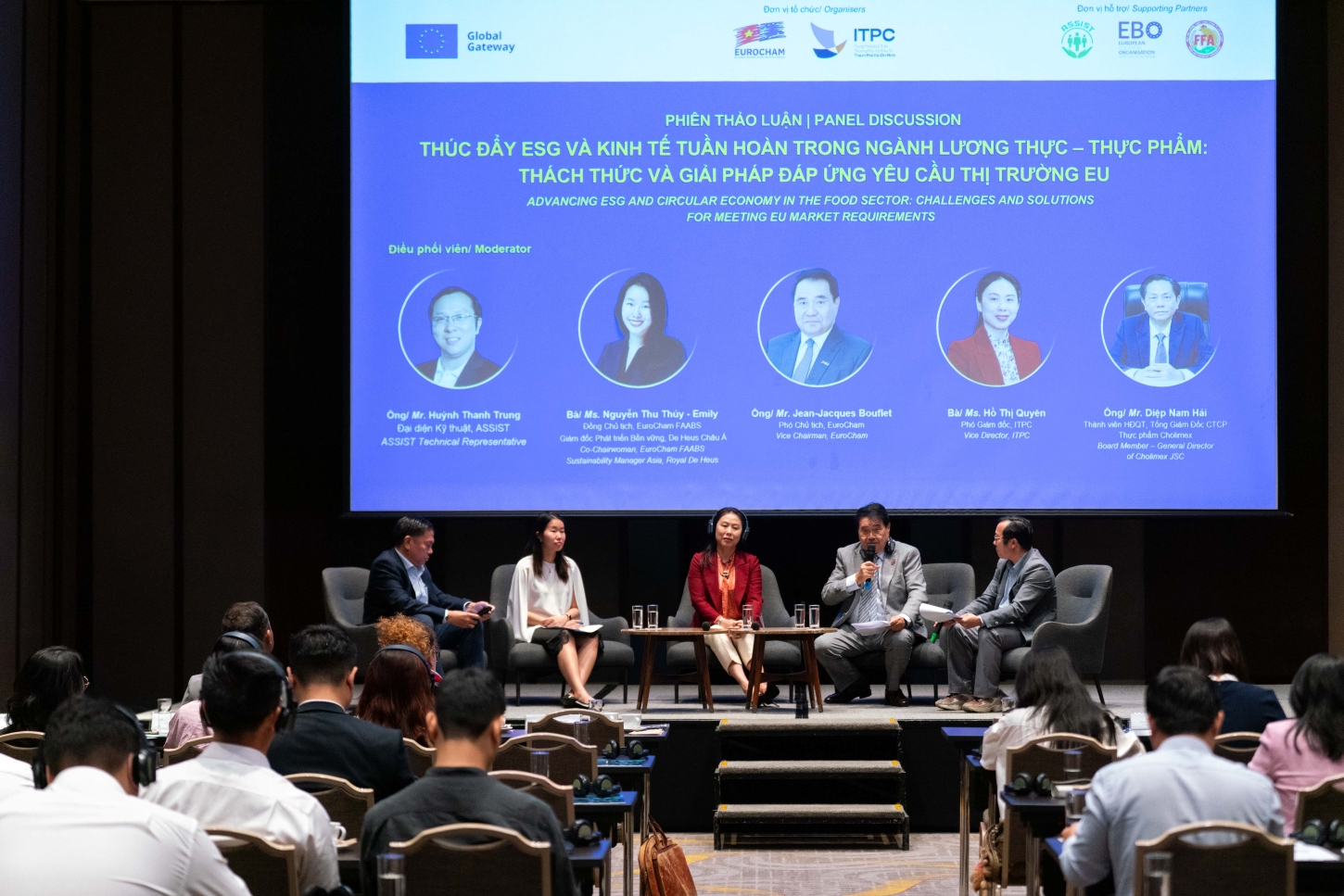
The seminar concluded with a panel discussion moderated by Mr. Huynh Thanh Trung, bringing together policy perspectives, industry experience, and technical expertise to discuss practical solutions for sustainable export transformation.
Through continued collaboration with ITPC and partners, EuroCham Vietnam remains committed to supporting Vietnamese businesses in navigating EU requirements, accelerating their green transition, and strengthening their position in European value chains. Together, these efforts aim to turn EVFTA opportunities into sustainable, long-term growth for Vietnam’s food industry.
Special thanks to all representatives for their contributions to the seminar’s success:
- Mr. Jean-Jacques Bouflet, Vice-Chair, EuroCham Vietnam
- Ms. Delphine Rousselet, Executive Director, EuroCham Vietnam
- Ms. Nguyen Thu Thuy, Co-Chairwoman FAABS, EuroCham Vietnam
- Ms. Nguyen Le Phuong Linh, Corporate Relations Manager cum Project lead, EuroCham Vietnam
- Mr. Truong Quang Truong, Senior Project Coordinator, EuroCham Vietnam
- Ms. Huynh Ngoc Thuy Duong, Project Officer, EuroCham Vietnam
- Ms. Ho Thi Quyen, Deputy Director, Ho Chi Minh City Investment and Trade Promotion Centre (ITPC)
- Mr. Le Huu Nghia, Vice Chairman, Ho Chi Minh City Union of Business Associations (HUBA)
- Mr. Trinh Ba Cuong, Secretary General, Food and Foodstuff Association of Ho Chi Minh City (FFA)
- Mr. Diep Nam Hai, Board Member and General Director, Cholimex Food JSC
- Mr. Aru David, Regional Director, ASSIST
- Mr. Huynh Thanh Trung, Technical Representative, ASSIST